

Dr. Marco Ha · Case editor and medical reviewer
Pediatric surgery, trauma surgery, hyperbaric and diving medicine · Last medically reviewed
Direct answer
What is a V-Y advancement flap for fingertip tissue loss?
When a fingertip defect cannot be closed without excessive tension or shortening, a V-Y advancement flap may—if the size and direction are suitable—move adjacent vascularized pulp tissue forward to cover the wound. The aim is to preserve useful fingertip length, padding and sensory potential. It is not appropriate for every fingertip amputation; bone, tendon, nail bed, nerves, perfusion, contamination and defect geometry must be assessed first.
This de-identified educational case does not guarantee flap survival, normal sensation, appearance or a particular return-to-work date.
His first question was not about pain: “Will I still be able to work?”
A manual worker arrived with a blood-soaked dressing around his finger. After the dressing was removed, the distal fingertip had a substantial soft-tissue defect.
He looked at his hand and asked, “Can this tissue be replaced? Will I still be able to work?” A fingertip provides far more than appearance: it contributes fine sensation, stable pinch and the confidence to hold a screwdriver or operate a machine safely.
Pulling the skin edges together under high tension might shorten the tip, compromise coverage or leave inadequate padding over bone. Planning therefore asked not only, “Can the wound be closed?” but also, “What length, padding, sensation and movement will remain for this person’s work?”
Dr. Ha’s clinical reasoning: defect geometry comes before a flap name
A V-Y advancement flap is one useful local reconstructive option, not a default for every fingertip wound. Assessment includes:
- Size and direction: selected transverse or dorsal-oblique defects may suit a volar V-Y design; volar-oblique, larger or thumb defects may require another approach.
- Exposed structures: bone, tendon, distal phalanx fracture, nail bed and germinal matrix injury all alter the plan.
- Nerves and perfusion: color, temperature, capillary refill, sensation and the amount of viable local tissue must be checked.
- Contamination and viability: oil, metal fragments, crush and avulsion may require wider debridement. Preserving length should never mean retaining clearly nonviable tissue.
- Work and health factors: hand dominance, occupation, smoking, diabetes, medication and the recovery the patient can safely accommodate matter.
How does a V-Y advancement flap work?
For a suitable fingertip defect, a V-shaped incision is designed in healthy adjacent pulp. The skin and subcutaneous tissue remain connected to their blood supply and are advanced toward the defect. Closing the donor site converts the V into a Y—hence “V-Y advancement flap.”
This is not a free piece of skin taken from a distant site, and it is not simply forcing wound edges together. Neighboring pulp can provide vascularized, padded coverage and sensory potential. Advancement is limited, however. Excessive movement increases tension and perfusion risk, so a larger or differently oriented defect may need another local flap, graft, shortening and closure, replantation, or selected nonoperative wound care.
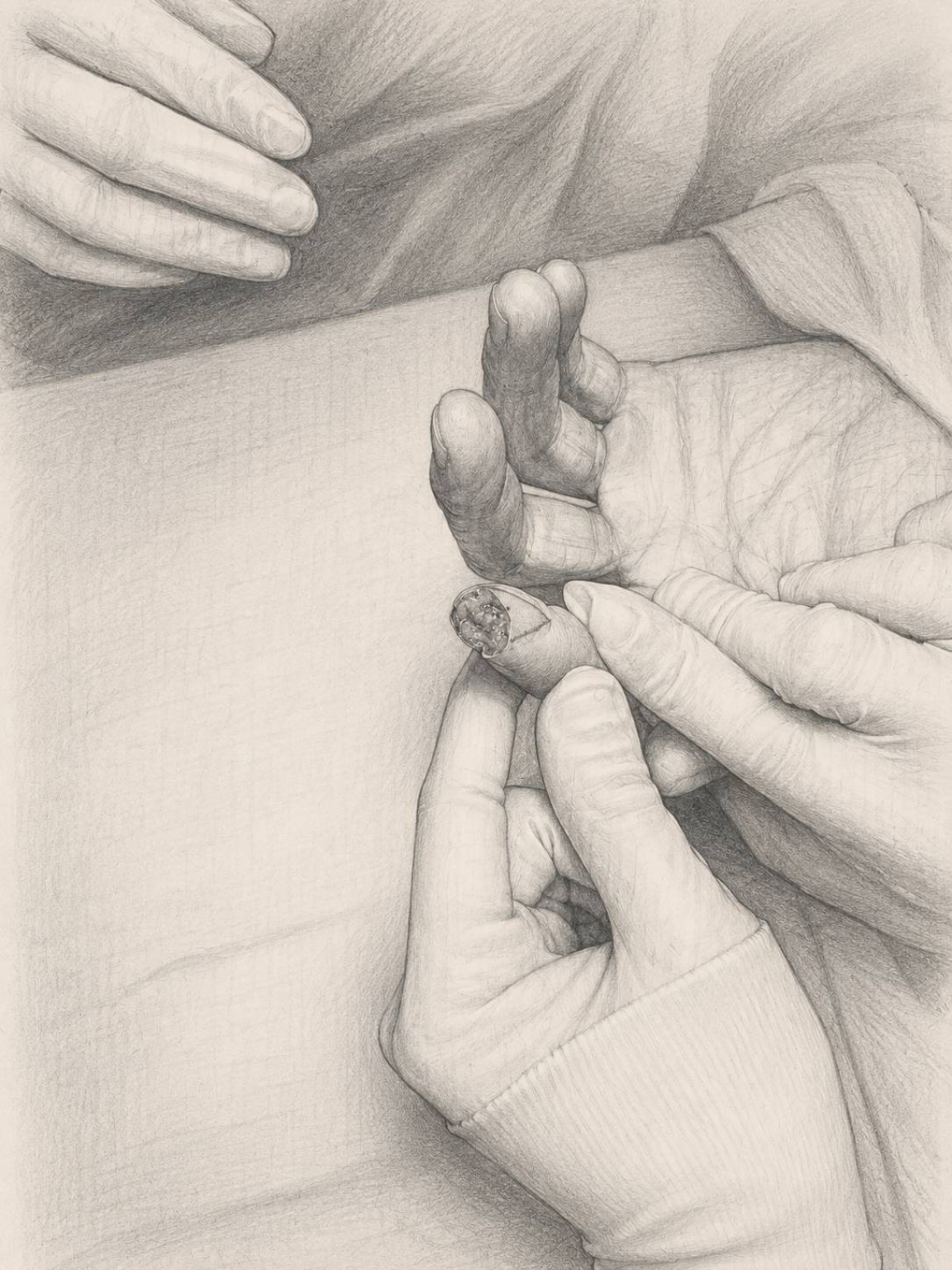
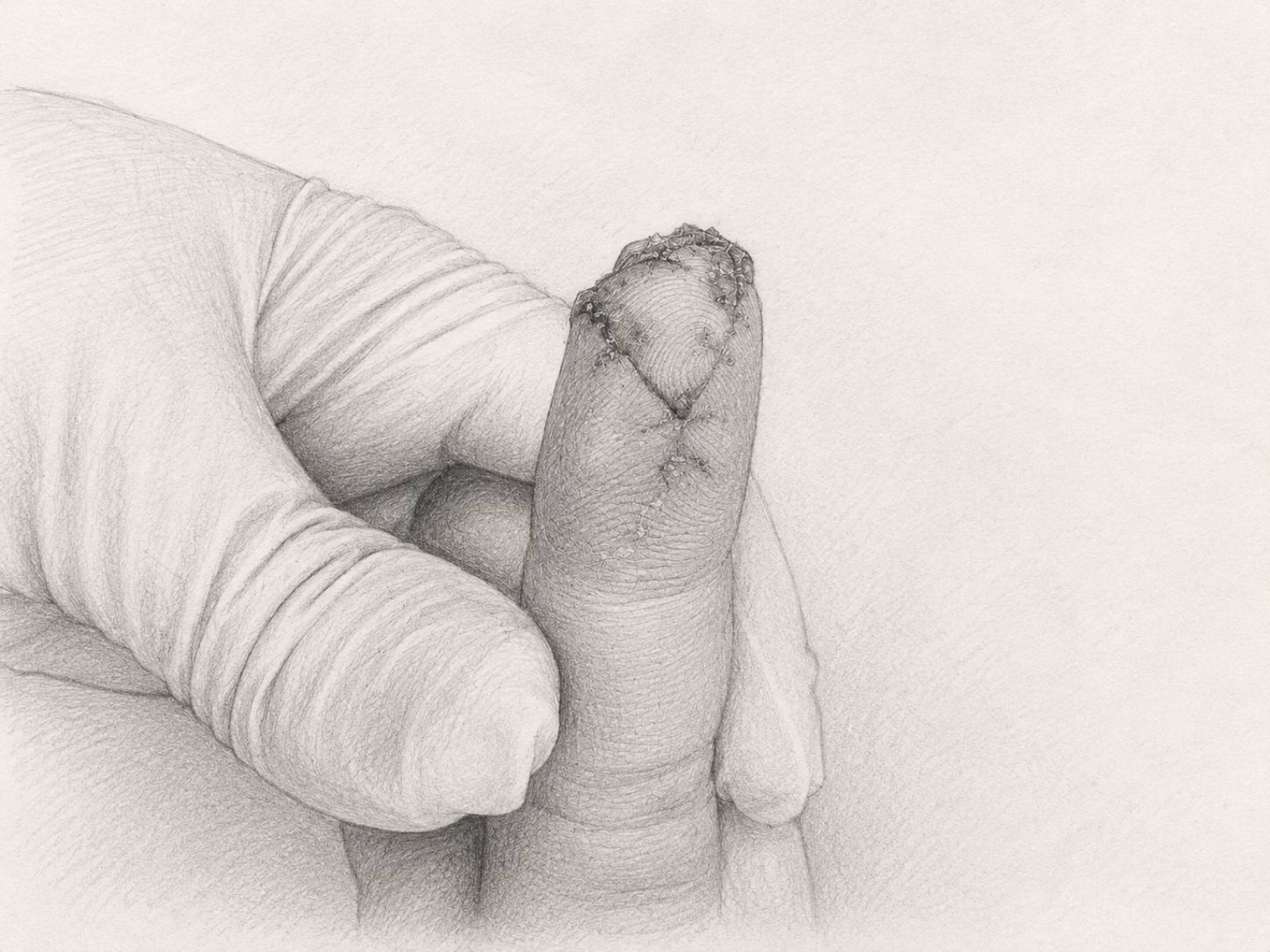
At two weeks, the surgeon checks perfusion; the patient asks about work
Two weeks later, the wound still had crusting and swelling. That is not the final result. Follow-up examines flap color, temperature, capillary refill, wound edges, infection and necrosis, then gradually assesses joint motion, sensation, pain and scar sensitivity.
The patient still wanted to know when he could return to work. A calendar alone cannot answer that. Desk duties, light handling, vibrating tools, heavy loads, heat, oil and high-speed machinery carry very different risks. Return should be staged according to wound closure, flap stability, pain, protective sensation, movement and job safety. Hand therapy, scar management and sensory re-education may be needed.
What should you do immediately after a fingertip cutting injury?
- Control bleeding: apply continuous direct pressure with clean gauze or cloth and elevate the hand above the heart. If blood soaks through, add material on top rather than repeatedly removing the dressing.
- Protect and immobilize: gently rinse obvious debris with clean water or saline if practical, cover the wound and reduce motion. Do not pack powders, herbs, coffee grounds or harsh chemicals into it.
- Bring any amputated part: gently rinse it, wrap it in clean moistened gauze, seal it in a watertight bag, and place the bag in a container of ice water. Do not put tissue directly on ice, freeze it or immerse it in water.
- Seek urgent care: persistent bleeding, exposed bone or tendon, a pale/blue/cold finger, numbness, loss of movement, heavy contamination, crush injury or amputation requires immediate emergency assessment.
- Report tetanus history: the medical team will assess vaccination and wound-management needs based on contamination and immunization history.
Common misconceptions
“It is a small wound; just stitch it.”
The fingertip contains nail structures, bone, tendon insertion, nerves, vessels and highly specialized sensation. A small surface wound may hide deeper injury and can require functional testing and imaging.
“A flap is the same as a skin graft.”
A graft is transferred skin that must revascularize from the wound bed. A flap moves tissue with its own blood supply and usually greater thickness. Their capabilities and indications differ.
“If the flap survives, sensation will be normal.”
Survival is only the first stage. Sensation, cold intolerance, scar sensitivity, pain and work endurance evolve over longer follow-up and depend on the original nerve injury and rehabilitation.
“Returning quickly proves the hand has recovered.”
Early friction, vibration, contamination or load can disrupt healing or cause another injury when protective sensation is reduced. A safe return must match the actual job.
Frequently asked questions
Does every fingertip tissue defect need a flap?
No. A small, shallow wound without exposed bone or tendon may heal with dressings. Larger defects, exposed structures or wounds that cannot close without excessive tension require individualized consideration of a flap, graft, shortening, replantation or other reconstruction.
Does a V-Y advancement flap take skin from another part of the body?
Usually no. It advances nearby, vascularized fingertip skin and subcutaneous tissue into the defect. Closing the donor area converts the original V-shaped incision into a Y.
Does a V-Y advancement flap guarantee normal sensation?
No. It uses neighboring pulp tissue to preserve useful length, padding and sensory potential, but numbness, hypersensitivity, pain, scarring or cold intolerance can still occur.
How should an amputated fingertip be transported?
Wrap it in clean moistened gauze, seal it in a watertight bag, and place that bag in a container with ice water. Do not place the tissue directly on ice or immerse it in water. Go to the emergency department immediately.
When can someone return to work after a V-Y flap?
There is no universal timeline. Wound healing, flap perfusion, pain, protective sensation, joint motion and job demands matter. Heavy machinery, vibration, heat and contaminated environments generally require more recovery than desk duties.
References
- AAOS OrthoInfo: Fingertip Injuries and Amputations
- American Society for Surgery of the Hand: Local and Regional Flaps
- Fingertip Amputation Reconstruction with V-Y Advancement Flap: literature review
- CDC: Clinical Guidance for Wound Management to Prevent Tetanus
Published defect classifications, techniques and follow-up vary. Group outcomes cannot be used as an individual treatment guarantee.
This clinical story has been de-identified and rewritten for education. Treatment and recovery vary with the injury and patient. Last updated August 20, 2026.